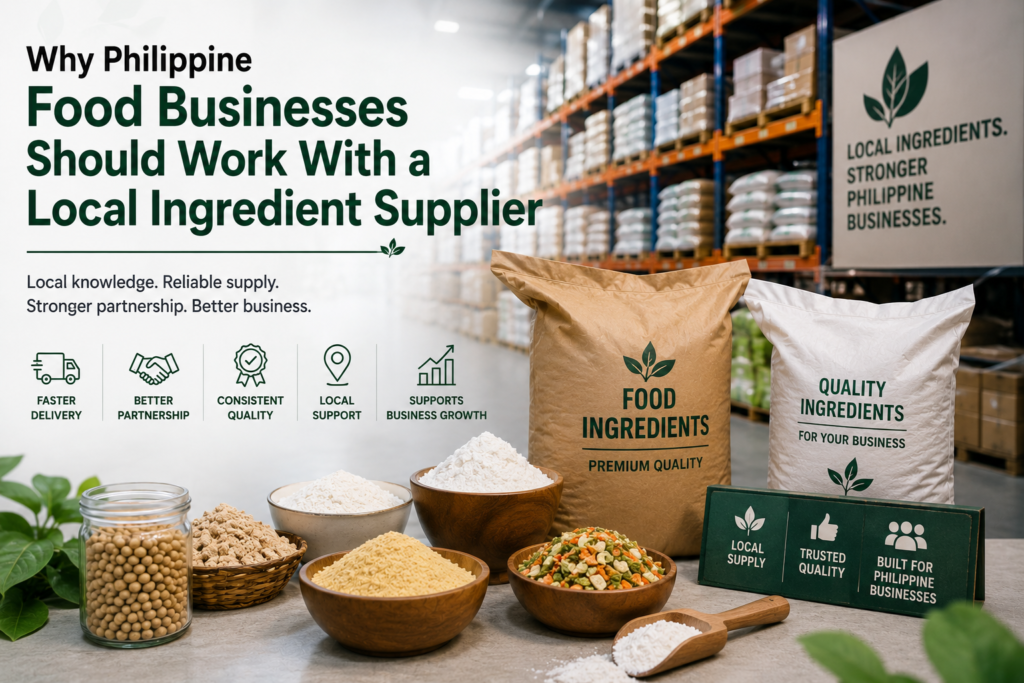
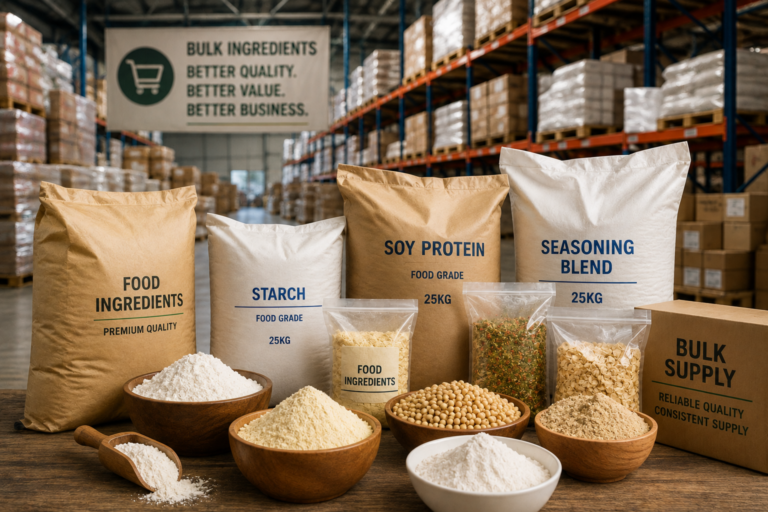
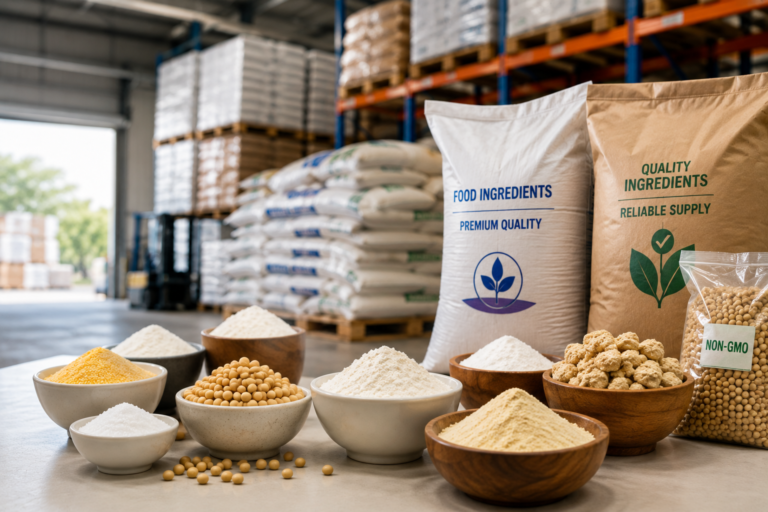
For food manufacturers, restaurants, food processors, bakeries, and foodservice businesses, having a dependable supply of ingredients is essential for keeping operations running smoothly.
While businesses can source ingredients from different suppliers and international markets, working with a local food ingredient supplier in the Philippines can offer several practical advantages. Local suppliers can provide easier communication, faster coordination, more convenient deliveries, and a better understanding of the needs of Philippine businesses.
The right supplier can become more than just a source of ingredients. It can become a valuable partner in managing procurement, inventory, production, and business growth.
What Is a Local Food Ingredient Supplier?
A local food ingredient supplier provides food ingredients to businesses within the Philippine market.
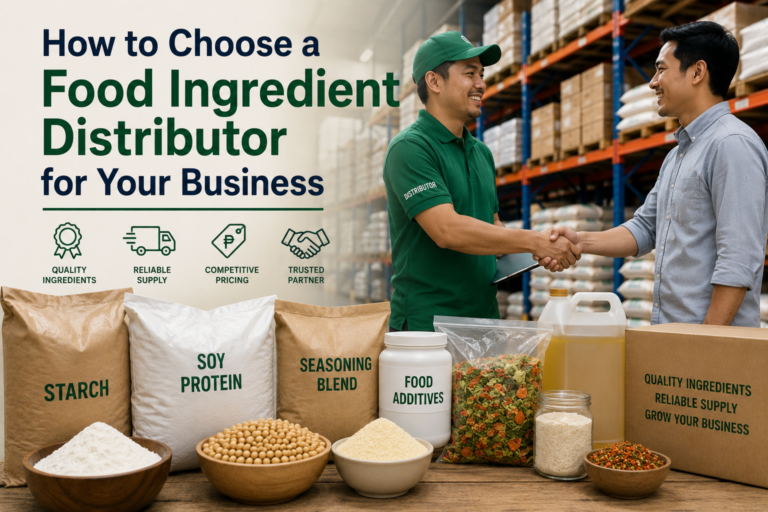
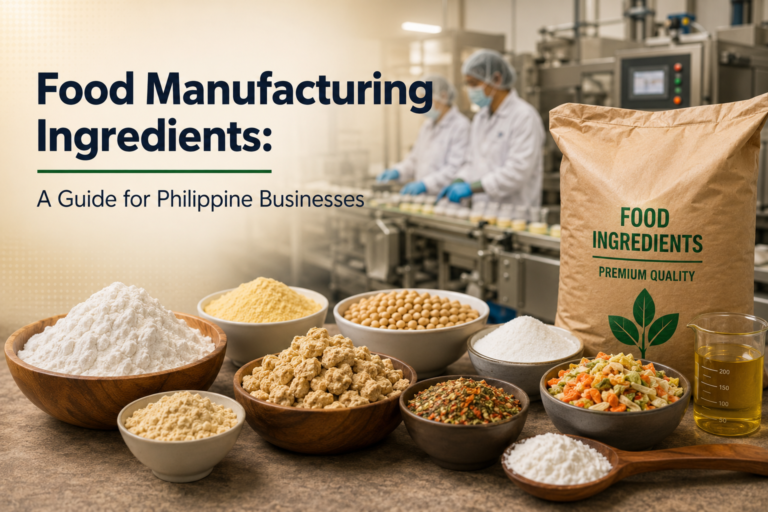
Depending on the supplier, products may include:
Starches and flours
Soy proteins
Seasonings and spice blends
Binders
Thickeners and stabilizers
Dehydrated ingredients
Food additives
Meat-processing ingredients
Other specialty food ingredients
These ingredients can be used by businesses across different food applications, from processed meat and sauces to bakery products, ready-to-eat foods, and foodservice products.
1. Easier Communication
One of the biggest advantages of working with a local supplier is easier communication.
When businesses need to check product availability, request quotations, discuss specifications, or arrange deliveries, communicating with a local supplier can make the process more straightforward.
For businesses that regularly purchase ingredients, responsive communication can save time and help prevent unnecessary delays.
A local supplier can also make it easier to discuss:
Product requirements
Order quantities
Delivery schedules
Pricing
Product samples
Documentation
Recurring orders
Good communication is especially important when a business has changing production requirements.
2. More Convenient Delivery Coordination
Food businesses often depend on ingredients arriving according to their production schedule.
Working with a local supplier can make delivery coordination easier because the supplier operates within the same local market.
Businesses can discuss delivery schedules based on their operational requirements and plan orders according to their expected consumption.
Reliable delivery can help reduce the risk of running out of essential ingredients during production.
3. Better Understanding of the Philippine Market
A supplier serving Philippine businesses is more familiar with the local food industry and the purchasing needs of businesses operating in the country.
Different businesses have different requirements based on their location, production scale, customer base, and product category.
A local supplier may better understand common purchasing patterns, commercial packaging requirements, delivery expectations, and the types of ingredients frequently used by Philippine food businesses.
This local market knowledge can make supplier coordination more efficient.
4. Easier Ordering and Reordering
For businesses with recurring ingredient requirements, a simple ordering process can make a significant difference.
Instead of repeatedly searching for suppliers, businesses can establish a relationship with a reliable local ingredient partner.
Once product specifications and ordering requirements are established, recurring purchases can become easier to manage.
This can be especially useful for businesses that regularly purchase:
A consistent ordering process also makes inventory planning easier.
5. Faster Response to Changing Demand
Food businesses do not always have predictable demand.
A restaurant may experience a sudden increase in orders. A manufacturer may receive a large customer order. A growing food brand may need to increase production faster than expected.
Having a local supplier can make it easier to communicate these changes and determine whether additional ingredients can be supplied.
The ability to quickly discuss increased requirements can be valuable when production schedules change.
6. Easier Product Sampling and Testing
Product testing is an important part of food manufacturing.
Before purchasing a large quantity of a new ingredient, businesses may want to test its performance in their formulation.
Working with a local supplier can make communication around samples and product evaluation more convenient.
Manufacturers can discuss:
This can help businesses make better purchasing decisions before committing to larger orders.
7. More Efficient Procurement
Managing multiple suppliers can make procurement complicated.
A business may need to communicate with different companies for different ingredients, delivery schedules, quotations, and invoices.
Working with a local supplier that offers several ingredient categories can potentially simplify the procurement process.
Instead of coordinating numerous individual suppliers, businesses may be able to consolidate some of their ingredient requirements through one supplier.
This can save administrative time and make purchasing easier to manage.
8. Better Inventory Planning
Reliable ingredient supply is closely connected to inventory management.
Businesses need to know how much inventory they have, how quickly ingredients are being consumed, and when another order needs to be placed.
A dependable local supplier can help businesses establish more predictable purchasing schedules.
For example, a manufacturer may arrange recurring deliveries based on its average monthly consumption.
This approach can help reduce two common inventory problems:
Too little inventory: Production may be interrupted because an essential ingredient is unavailable.
Too much inventory: Excess stock may occupy valuable storage space and increase inventory costs.
The goal is to maintain an appropriate supply based on actual business requirements.
9. Potentially Lower Supply-Chain Complexity
International sourcing can involve multiple stages, including overseas transportation, customs procedures, international logistics, and additional coordination.
For businesses that need ingredients regularly, a local supplier can provide a simpler purchasing relationship within the Philippine market.
This does not mean international sourcing is unsuitable for every business. Imported ingredients can be important for products that are unavailable locally or require specific specifications.
However, when suitable ingredients are available through a reliable local supplier, local sourcing can simplify part of the procurement process.
10. Easier Customer Support
When an ingredient issue occurs, businesses need answers quickly.
For example, a manufacturer may need to ask about:
Product availability
Recommended usage
Packaging
Storage
Delivery
Product specifications
Alternative products
Having a local supplier can make these conversations easier to coordinate.
A responsive supplier can also help businesses address purchasing concerns before they become larger operational problems.
11. Support for Growing Philippine Businesses
Small and medium-sized food businesses often change rapidly.
A business may start with small production volumes and gradually expand into larger manufacturing operations.
As production grows, ingredient requirements may increase as well.
A local supplier can potentially support this growth by providing:
Establishing a supplier relationship early can make it easier to manage procurement as the business expands.
12. Building a Long-Term Supplier Partnership
The strongest supplier relationships go beyond individual transactions.
A business that regularly works with the same supplier can develop a better understanding of each other’s requirements.
Over time, the supplier can become familiar with:
This familiarity can make future purchasing more efficient.
A strong supplier relationship can also provide businesses with a reliable point of contact when they need new ingredients or are developing new products.
What Should You Look for in a Local Ingredient Supplier?
Choosing a local supplier does not automatically guarantee good service or product quality.
Businesses should still evaluate potential suppliers carefully.
Consider the following factors:
Product Quality
Ingredients should meet the specifications required for your application and production process.
Product Availability
The supplier should be able to maintain a dependable supply of frequently used products.
Competitive Pricing
Compare prices while also considering product performance, delivery, packaging, and overall value.
Delivery Reliability
The supplier should have a practical process for fulfilling orders and coordinating deliveries.
Product Documentation
Ask about available product specifications and other relevant documentation.
Customer Service
The supplier should respond promptly to questions, quotations, and order-related concerns.
Technical Knowledge
For manufacturers, a supplier with knowledge of food applications can provide additional value when selecting ingredients.
Scalability
The supplier should ideally be able to support your business as order volumes increase.
Local Supplier vs. International Supplier
Both local and international suppliers can have an important role in the food industry.
International suppliers may be appropriate when businesses require specialized ingredients, specific origins, or products that are not readily available through local channels.
However, local suppliers can offer practical advantages when businesses prioritize:
The best approach depends on the specific requirements of each business.
Questions to Ask a Local Ingredient Supplier
Before establishing a supplier relationship, ask:
What ingredients do you currently supply?
What industries do you serve?
What are your minimum order quantities?
Do you offer bulk pricing?
What is your typical delivery lead time?
Are recurring orders available?
Can you provide product samples?
What product documentation is available?
Can you support larger production volumes?
Can you recommend ingredients for specific food applications?
The answers can help you determine whether the supplier is a good fit for your business.
Why Local Sourcing Can Make Sense for Philippine Food Businesses
For many Philippine food businesses, ingredient sourcing is an ongoing operational requirement rather than a one-time purchase.
Restaurants need reliable ingredients for daily operations. Food manufacturers need consistent raw materials for production. Food processors need ingredients that meet specific formulation requirements.
A dependable local supplier can help simplify these processes by providing a consistent point of contact for ingredient sourcing, ordering, and delivery coordination.
The key is to choose a supplier based on quality, reliability, availability, service, pricing, and long-term capability rather than location alone.
Partner With a Local Food Ingredient Supplier
Choosing the right ingredient supplier can have a significant impact on a food business.
For Philippine businesses, working with a reliable local supplier can provide practical advantages in communication, delivery coordination, procurement, inventory planning, and ongoing support.
Whether you operate a food manufacturing facility, restaurant, meat-processing business, bakery, foodservice operation, or growing food brand, having a dependable ingredient partner can help create a more efficient and predictable supply chain.
Looking for a Local Food Ingredient Supplier in the Philippines?
Fudsource provides food ingredients and solutions for businesses in the Philippine food manufacturing, processing, and foodservice industries.
From bulk ingredients to food processing solutions, Fudsource works with businesses looking for reliable ingredient sourcing and products suited to their specific requirements.